Decorative chart. It shows a passage plan crossing the Bay of Biscay, passing the Dover Strait and running north-east through the North Sea emission control area to an EU port call. That is the voyage GreenETS reports on. No information here is missing from the text below.
Services
Thirteen service lines, from statutory documentation and technical files through to the onboard systems and the financing framework around them. Open any one to read it in full.
Jump to a service
01
EU MRV, EU ETS and FuelEU Maritime
Reg. (EU) 2015/757 · EU ETS maritime extension · Reg. (EU) 2023/1805
As of July 14, 2021, the European Commission has taken significant strides towards achieving climate neutrality in the EU by 2050. This includes an ambitious intermediate target of at least a 55% net reduction in greenhouse gas emissions by 2030. The legislative proposals put forth by the Commission outline a comprehensive strategy, revising key EU climate legislation, and aligning with the European Green Deal.
Read more Show less about EU MRV, EU ETS and FuelEU Maritime
Crucial to the success of this strategy is the robust monitoring and reporting of greenhouse gas emissions, particularly within the EU Emissions Trading System (EU ETS). Greenships recognizes the importance of compliance with these standards and has implemented a meticulous process to ensure adherence to the EU MRV (Monitoring, Reporting, and Verification) and EU ETS requirements.
The annual compliance cycle, encompassing monitoring, reporting, and verification (MRV), is a cornerstone of the EU ETS. Operators covered by the EU ETS are required to hold an approved monitoring plan before they report annual emissions. For shipping that plan sits with the vessel and the company responsible for it, and it is what the verifier checks the year against.
On an annual basis, operators submit emissions reports, which are then verified by accredited verifiers. This verification process is crucial for maintaining the integrity of the EU ETS. Greenships, recognizing the importance of timely and accurate data, employs a dedicated AI-powered application for data collection. This application ensures that every correction is made promptly to achieve the most accurate results on the Carbon Intensity Indicator (CII).
Greenships not only fulfills regulatory obligations under the Monitoring and Reporting Regulation (MRR) and Accreditation and Verification Regulation (AVR) but goes beyond, demonstrating a commitment to excellence in environmental stewardship. The use of AI technology adds an extra layer of precision to the compliance process, aligning with the European Commission's vision for a transparent, consistent, and accurate greenhouse gas emissions reporting system.
The commitment to adherence is further underscored by the proactive approach to provide guidance, exemplars, and tools to ensure a harmonized and cost-effective application throughout all EU ETS countries. Greenships stands as a beacon of compliance, utilizing technology to navigate the complex landscape of EU MRV and EU ETS, contributing to the broader goals of the European Green Deal.
Furthermore, in the face of penalties for excessive emissions, Greenships prioritizes accurate reporting to avoid penalties and maintain a commitment to sustainability. The penalty for non-compliance serves as an additional incentive for operators to adhere strictly to the EU MRV and EU ETS standards.
In summary, Greenships, through its dedication to precision, transparency, and technological innovation, plays a vital role in ensuring the success of the EU's climate targets. By collecting client vessels' data with its AI-powered application, Greenships contributes to the overall effectiveness of the EU MRV and EU ETS, fostering a culture of environmental responsibility and sustainability in the maritime industry.
FuelEU Maritime
FuelEU Maritime, Regulation (EU) 2023/1805, is the third EU obligation to land on the same voyage data. Where the ETS puts a price on the carbon a ship emits, FuelEU sets a limit on the greenhouse gas intensity of the energy it uses, measured Well-to-Wake rather than at the funnel. The two are calculated from the same bunker records but they answer different questions, and a fleet can sit comfortably inside one while failing the other.
We calculate the attained GHG intensity for each vessel, the compliance balance that follows from it, and the penalty exposure when that balance is negative. Because a surplus can be banked or pooled across vessels, the figure is worth knowing while the year is still running rather than after it closes.

02
IMO DCS, CII and GFI
MARPOL Annex VI · MEPC.354(78) · IMO Net-Zero Framework
Greenships stands as an exemplar of industry-leading environmental stewardship, setting a commendable standard in the maritime sector. At the heart of their commitment is the seamless integration of cutting-edge technology and unwavering dedication to regulatory compliance.
Read more Show less about IMO DCS, CII and GFI
Central to Greenships' success is their adherence to the International Maritime Organization Data Collection System (IMO DCS). In navigating the complexities of this regulatory landscape, Greenships distinguishes itself by employing an advanced AI-powered application. This technology ensures the timely and accurate collection of client vessel data, a task mandated by the IMO for ships of 5,000 gross tonnage and above.
The use of artificial intelligence in Greenships' operations goes beyond mere compliance. It is a testament to their proactive approach to environmental sustainability. The dedicated AI application plays a pivotal role in meticulously correcting and validating collected data, with the overarching goal of achieving the utmost accuracy in the reported Carbon Intensity Indicator (CII).
By seamlessly integrating IMO DCS requirements with advanced AI capabilities, Greenships not only fulfills regulatory obligations but also elevates the standard of data-driven decision-making in the maritime industry. This harmonious blend of compliance and technological innovation positions Greenships as a leader, providing clients with actionable insights for navigating the evolving landscape of environmental sustainability in maritime operations.
Greenships' commitment to precision and excellence in data collection extends beyond meeting regulatory standards. It signifies their dedication to being at the forefront of technological innovation. Clients benefit not only from compliance but from a service that actively contributes to a proactive strategy for optimizing operational carbon intensity.
This holistic approach is a testament to Greenships' unwavering commitment to environmental responsibility. As the maritime industry evolves, Greenships remains a beacon of excellence, demonstrating that environmental stewardship and technological innovation can go hand in hand, paving the way for a sustainable and responsible future in maritime operations.
GHG Fuel Intensity, the IMO Net-Zero Framework
The IMO has drafted a fuel standard of its own. GHG Fuel Intensity, or GFI, would set a declining Well-to-Wake intensity limit for ships over 5,000 gross tonnage on international voyages, backed by a two-tier pricing mechanism for the shortfall. It was approved at MEPC 83 in April 2025 and is written to become a new Chapter 5 of MARPOL Annex VI.
It is not adopted yet. The extraordinary session in October 2025 closed without agreement and the decision now sits with MEPC 85, with application phased from 2027 if it passes. We model GFI today from the same bunker and voyage records the other regimes already use, so a fleet can see where it would stand before the rule arrives rather than after. We follow the drafting and keep the calculation current as the text moves.
03
Creating and Evaluating Green Loan Projects
Greenships is at the forefront of pioneering sustainable shipping practices, offering a comprehensive suite of Green Loan Projects designed to reduce greenhouse gas (GHG) emissions and enhance the environmental performance of vessels. Our work extends beyond evaluation. We create these projects, implement them, and secure approval for them.
Read more Show less about Creating and Evaluating Green Loan Projects
Our Green Loan Projects cover a broad spectrum of initiatives, ranging from propulsion improvement to advanced propeller blade design. Each project is meticulously crafted to address the specific needs of different vessel types and sizes, ensuring a tailored and effective approach to reducing carbon footprints in the maritime industry.
The projects include, but are not limited to, optimizing battery-powered engines, improving engine nozzles, implementing engine power limitation strategies, and exploring alternative power sources such as solar and wind generation. We evaluate the feasibility and efficacy of each technology, staying abreast of the latest advancements to provide our clients with state-of-the-art solutions.
Greenships takes a holistic approach to sustainability, considering technologies like Flettner rotors, hybrid auxiliary power generation, kites and sails, and waste heat recovery. These initiatives are not only environmentally conscious but also economically viable, contributing to the long-term success and competitiveness of our clients in the maritime industry.
We understand the importance of gaining approval from classification societies (RO) and financial institutions for the successful implementation of these projects. Our team of experts is well-versed in navigating the complex approval processes, ensuring that each project aligns with regulatory standards and financial requirements.
Once approved, we actively apply these projects to our clients' vessels, closely observing their performance to maintain sustainability and maximize efficiency. Whether it's anti-fouling hull coatings, hull cleaning, or advanced weather routing and voyage optimization, Greenships is dedicated to making a positive impact on the environmental footprint of the maritime sector.
Our commitment extends to exploring innovative technologies such as counter-rotating propellers, hull air lubrication, and rotor sails. By consistently evaluating and adopting the latest advancements, Greenships positions itself as a leader in the field, guiding our clients towards a more sustainable and environmentally friendly future.
Greenships is particularly proud of its expertise in LNG/ammonia-fueled engine operations, an area crucial for the transition to cleaner energy sources. We believe in the transformative power of green initiatives, and our dedication to projects like propeller tip winglets, propeller/hull interaction, rudder optimization, and propeller ducts or nozzles underscores our commitment to driving positive change in the industry.
Our approach also includes the application of technologies like hull ducts or fins, propeller boss cap fins, and hull cleaning to enhance vessel performance. By considering the entirety of a vessel's operation, Greenships ensures that our projects not only reduce GHG emissions but also contribute to the overall efficiency, safety, and reliability of maritime transportation.
Greenships is proud to be a key player in the adoption of sustainable practices in the maritime industry. Our commitment to hull air lubrication, propeller surface polish, and other cutting-edge technologies reflects our dedication to providing our clients with a competitive edge in a rapidly evolving and environmentally conscious sector.
As we advocate for a cleaner and more efficient maritime industry, Greenships actively explores technologies like hull ducts or fins, propeller boss cap fins, and propeller tip winglets. These innovations play a crucial role in shaping the future of shipping, reducing environmental impact, and promoting a more sustainable and responsible approach to maritime operations.
We recognize the importance of the propeller/hull interaction, and our projects are designed to optimize this crucial relationship for improved efficiency. Whether it's through rudder optimization or the application of counter-rotating propellers, Greenships is committed to maximizing the benefits of these technologies to create a positive and lasting impact on our clients' vessels.
At Greenships, we believe that the integration of rotor sails, alongside other advanced technologies, holds great potential in revolutionizing the maritime industry. Our dedication to exploring possibilities like weather routing and voyage optimization aligns with our vision for a future where vessels operate with minimal environmental impact while maximizing their economic viability.
Our commitment extends to initiatives such as hull air lubrication, propeller ducts or nozzles, and propeller boss cap fins. By actively participating in the development and application of these technologies, Greenships aims to be a driving force in the pursuit of a more sustainable and eco-friendly maritime industry.
Greenships takes pride in offering a holistic and multifaceted approach to sustainable shipping. Our dedication to projects like waste heat recovery, anti-fouling hull coatings, and propeller surface polish reflects our commitment to addressing environmental concerns while simultaneously optimizing vessel performance.
Our projects also encompass the utilization of LNG/ammonia-fueled engines, recognizing the pivotal role these alternative fuels play in reducing the carbon footprint of maritime operations. By actively promoting and implementing these initiatives, Greenships is at the forefront of the transition to cleaner and more sustainable energy sources in the maritime industry.
We understand that each vessel is unique, and our approach to green initiatives is tailored to the specific needs and characteristics of different vessels. Our commitment to weather routing and voyage optimization, alongside other advanced propeller blade designs and hull cleaning strategies, ensures that our projects are not only effective but also adaptable to the diverse requirements of our clients.
Greenships actively explores technologies such as rotor sails, recognizing their potential to contribute significantly to the reduction of GHG emissions in the maritime industry. Our commitment to the application of advanced technologies, including hull air lubrication, propeller boss cap fins, and propeller tip winglets, underscores our dedication to being at the forefront of sustainability in maritime transportation.
As a key player in sustainable shipping, Greenships is proud to contribute to the industry's evolution through initiatives like propeller ducts or nozzles, rudder optimization, and the integration of counter-rotating propellers. These technologies represent our commitment to staying ahead of the curve and actively shaping a future where vessels operate with maximum efficiency and minimal environmental impact.
Our dedication to LNG/ammonia-fueled engines is a testament to our commitment to driving positive change in the maritime sector. By actively participating in projects like weather routing and voyage optimization, hull air lubrication, and propeller surface polish, Greenships ensures that our clients are not only compliant with regulations but also well-positioned to thrive in a sustainable and eco-conscious maritime landscape.

04
Creating Green Financing Framework (GFF) for Maritime Organizations
Greenships stands as a beacon of sustainability in the maritime industry, offering not just innovative Green Loan Projects but also a holistic Green Financial Framework for maritime organizations, ship owners, and managers. This framework is meticulously designed to align financial strategies with the adoption of sustainable technologies, ensuring a seamless transition to eco-friendly and economically viable maritime operations.
Read more Show less about Creating Green Financing Framework (GFF)
Understanding the Green Financial Framework
At the core of the Green Financial Framework are our Green Loan Projects, encompassing a diverse array of initiatives to reduce greenhouse gas (GHG) emissions. These projects, such as propulsion improvement, hybrid power generation, and advanced propeller blade design, serve as the foundation for a financially sound and environmentally conscious approach to maritime operations.
We understand that the financial landscape plays a pivotal role in shaping the industry's future. Greenships actively collaborates with maritime organizations, ship owners, and managers to craft financial strategies that not only support the adoption of sustainable technologies but also enhance overall operational efficiency and profitability.
The Benefits of the Green Financial Framework
-
Sustainable Financial Strategies
The Green Financial Framework ensures that financial strategies are aligned with sustainability goals. It goes beyond conventional financial models, integrating green finance principles into the core of decision-making processes.
-
Mitigation of Financial Risks
By conducting a thorough analysis of current financial structures, the framework identifies potential risks associated with the adoption of green technologies. It provides strategies to mitigate these risks, ensuring a smooth transition to sustainable operations.
-
Access to Green Financing
Greenships actively explores various funding options, including green loans, grants, and incentives that align with sustainability goals. This expands financial opportunities for maritime organizations, making it more attractive for lenders and investors.
-
Transparent Financial Projections
The Green Financial Framework prioritizes transparency and accountability. Clients receive clear and comprehensive financial projections, outlining the anticipated costs, savings, and returns associated with each Green Loan Project.
-
Collaboration with Financial Institutions
Greenships fosters partnerships with financial institutions that share a vision for a sustainable maritime future. This collaboration results in favorable financing terms for clients, creating a win-win situation where financial institutions recognize and reward sustainable practices.
-
Compliance with Regulatory Standards
The framework ensures that maritime organizations adhere to relevant green finance regulations and reporting standards. This proactive approach safeguards against regulatory risks and positions clients as responsible and forward-thinking leaders in the industry.
-
Performance-Based Financing
Innovative financial structures, such as performance-based financing and green bonds, directly tie financial incentives to the successful implementation and performance of sustainable technologies. This aligns financial interests with environmental stewardship.
-
Education and Capacity Building
Greenships provides training and resources to empower maritime organizations, ship owners, and managers in navigating the complexities of green finance. This knowledge transfer ensures that clients are well-equipped to make informed financial decisions that align with sustainability goals.
-
Ongoing Assessment for Continuous Optimization
Our financial experts conduct ongoing assessments to track the financial performance of implemented Green Loan Projects. This iterative approach allows for continuous optimization, identifying opportunities for further cost savings and efficiency improvements.
-
Flexibility and Adaptability
The Green Financial Framework is designed to be flexible, allowing for adjustments and refinements in response to changing market conditions, regulatory landscapes, and technological advancements. This adaptability ensures that clients remain at the forefront of sustainable finance in the maritime industry.
-
Integration of Sustainability into Business Strategy
Collaboration is at the heart of the Green Financial Framework. We work closely with clients to integrate sustainability into their overall business strategy. This includes exploring opportunities for revenue generation through eco-friendly initiatives, enhancing market competitiveness.
-
Innovative Financial Modeling
Our commitment to innovation extends to financial modeling and risk assessment. We leverage advanced analytics and modeling tools to simulate various financial scenarios, allowing clients to make data-driven decisions that ensure long-term success.
-
Partnership Building
Greenships actively explores partnerships with green finance advocates, industry associations, and governmental bodies. These collaborations aim to create a supportive ecosystem that incentivizes and accelerates the adoption of sustainable financial practices in the maritime sector.
-
Resilience in the Face of Uncertainty
The Green Financial Framework is a strategic approach to financial transformation rather than a set of guidelines. By integrating sustainability into financial decision-making, Greenships empowers maritime organizations to pioneer a new era of responsible and resilient maritime operations.
-
Sustainability as a Competitive Advantage
Greenships believes that sustainability should not be a cost but an investment in the future. The Green Financial Framework positions sustainable practices as a source of competitive advantage, attracting environmentally conscious investors, partners, and customers.
-
Financial Success Aligned with Environmental Stewardship
Through the Green Financial Framework, Greenships propels its clients towards a future where financial success and environmental stewardship go hand in hand. The framework ensures that every financial decision contributes to a greener and more sustainable maritime industry.
-
Transparency in Financial Reporting
Greenships is committed to transparency in financial reporting. As part of the Green Financial Framework, we assist clients in developing comprehensive sustainability reports that showcase the positive environmental and financial impact of adopting green finance practices.
-
Empowering Maritime Organizations
Greenships actively explores technologies such as rotor sails, recognizing their potential to contribute significantly to the reduction of GHG emissions in the maritime industry.
-
Adaptable to Diverse Requirements
We understand that each vessel is unique, and our approach to green initiatives is tailored to the specific needs and characteristics of different vessels.
-
Propelling Positive Change
As a key player in sustainable shipping, Greenships is proud to contribute to the industry's evolution through initiatives like propeller ducts or nozzles, rudder optimization, and the integration of counter-rotating propellers. These technologies represent our commitment to staying ahead of the curve and actively shaping a future where vessels operate with maximum efficiency and minimal environmental impact.
05
Voyage-based EU ETS and FuelEU Cost
What a voyage costs in carbon, before and after it is sailed
Carbon is now a line in the voyage estimate. A charterer deciding between two employments, or an owner pricing a fixture, needs the allowance obligation and the FuelEU exposure alongside the bunker bill rather than months later. GreenETS answers that question twice, once before the voyage and once from the reports that came off the bridge.
Read more Show less about Voyage-based EU ETS and FuelEU Cost
Before the voyage
The estimator takes a voyage plan typed straight in. An origin port and up to two legs, each with its destination, speed, bunker type, consumption at sea and time in port. Sea distance and the distance inside an Emission Control Area are calculated from the port pair, and each leg is classified as EU, UK or IMO scope from the ports themselves, which is what sets the differentiating percentage.
Out of that come the required EU allowances, the EU ETS cost in euro at the most recent stored EUA price with the date that price was captured, the FuelEU compliance balance and penalty in euro, and a combined figure. The ECA zones are drawn on a map so the scope classification can be checked by eye. The result is shown on screen for the decision at hand.
After the voyage
The chartering tool works from voyage reports the crew has already filed. Pick a vessel, pick a year, tick the first and last report of the passage, and every report in between is included. From the bunker records on those reports it produces the required EU allowances per fuel, the FuelEU energy used, Well-to-Tank, Tank-to-Wake and Well-to-Wake emissions with their intensities, the compliance balance against the target and the penalty in euro.
A report can be requested from that result. It is rendered in the background and arrives by email as a PDF carrying the ship's particulars, the period, the source report numbers, the voyage numbers and charterer, the emission factors used and the regulatory citations behind them.
06
IHM Supplier Declarations and SDoC
Material Declarations and the Supplier’s Declaration of Conformity
Keeping an Inventory of Hazardous Materials current is not a documentation problem, it is a chasing problem. Every purchase that goes aboard needs a Material Declaration from the supplier and a Supplier’s Declaration of Conformity covering the delivery, and most of the effort goes into getting them back. GreenETS runs that exchange end to end.
Read more Show less about IHM Supplier Declarations and SDoC
The office side starts from a spreadsheet. Download the template, list the purchased products against one vessel, one supplier and one purchase order, and upload it. Each row becomes a Material Declaration with its own reference, and the package gets a single SDoC. Send the request and the supplier receives it by email. Anything still outstanding is chased automatically after a day, and the reminders keep going until the package comes back.
The supplier works in their own portal. For each declaration they state, material by material across Table A and Table B, whether it is present above its threshold value, and where it is, the mass, the unit and where it is used. They complete the SDoC header and its list of conformity documents, which arrives pre-filled with MEPC.379(80), the EU Ship Recycling Regulation (EU) No 1257/2013, the EMSA Best Practice Guide on the IHM and the AFS Convention.
Signing is electronic and it closes the package. Eight required fields are checked first, then the declaration locks, the SDoC and every Material Declaration are rendered as A4 PDFs, the SDoC is hashed, and the whole set is bundled into a ZIP for the company to file. The signed SDoC carries a QR code that opens a public verification page, so anyone holding a copy can confirm it against the record.
07
Pre-Purchase GHG Evaluation
As the maritime industry continues to evolve under the ambitious targets set by the International Maritime Organization (IMO) for zero greenhouse gas (GHG) emissions by 2050, the implementation of the European Union Emissions Trading System (EU ETS) tax, and the commitment to the Poseidon Principles, Greenships stands as a pioneering force in ensuring our clients are well-prepared for the changing regulatory landscape.
Read more Show less about Pre-Purchase GHG Evaluation
In response to these crucial industry shifts, Greenships offers a comprehensive Pre-Purchase GHG Evaluation Report to our clients. This report is meticulously crafted, taking into account not only the IMO regulations on achieving zero GHG emissions by 2050 but also the nuances of the EU ETS tax system and adherence to the Poseidon Principles.
Our evaluation goes beyond current regulations, considering the potential impact of upcoming rules and industry standards. By engaging with Greenships for a Pre-Purchase GHG Evaluation Report, our clients gain a strategic advantage in understanding the environmental and financial implications associated with their vessel acquisitions.
We navigate the complexities of the regulatory landscape, providing a detailed analysis that enables informed decision-making. Our commitment is to empower our clients to align with global sustainability goals, remain compliant with evolving regulations, and make environmentally conscious investments.
Choose Greenships for a forward-looking approach to vessel acquisitions. Our Pre-Purchase GHG Evaluation Report is a valuable tool in ensuring that every investment not only meets current regulatory standards but is also future-proofed for the zero GHG emission targets of 2050 and beyond.

08
EEDI & EEXI Optimisation
Energy Efficiency Design & Existing Ship Index
At Greenships, we understand the challenges that shipowners face when preparing Energy Efficiency Design Index (EEDI) and Energy Efficiency Existing Ship Index (EEXI) Technical Files. In some cases, the lack of available data or unsuitable data can result in values that are higher than they should be. This discrepancy may lead to the unnecessary use of costly energy-saving devices or imposing high levels of power limitation on the main engine.
Read more Show less about EEDI & EEXI Optimisation
Recognizing the impact this can have on operational efficiency and costs, Greenships offers our clients a comprehensive service to check every possibility to improve their EEDI and/or EEXI Technical Files. Our dedicated team meticulously examines every parameter as per regulations, ensuring that the files accurately reflect the reality of the ship's energy efficiency.
We understand that each vessel is unique, and our approach is tailored to consider the specific challenges and opportunities presented by the ship in question. By leveraging our expertise and utilizing advanced analytical tools, including our dedicated professional software powered by Artificial Intelligence, we aim to optimize EEDI and EEXI values for our clients.
Choosing Greenships means choosing a partner committed to excellence in regulatory compliance and operational efficiency. e work collaboratively with our clients to navigate complexities, rectify discrepancies, and ensure that their vessels operate with the most accurate and efficient EEDI and EEXI values possible.
Our goal is to empower shipowners to make informed decisions, avoid unnecessary costs, and contribute to a more sustainable and environmentally conscious maritime industry. Greenships is your ally in the journey towards optimal energy efficiency and compliance.

09
Preparation of EEXI Technical File
Energy Efficiency Existing Ship Index
As part of our unwavering commitment to reducing greenhouse gas emissions in the maritime industry, Greenships actively engages in the preparation of Energy Efficiency Existing Ship Index (EEXI) Technical Files for our clients. Introduced by the International Maritime Organization (IMO), the EEXI is a crucial measure aimed at enhancing the technical design of ships to minimize environmental impact.
Read more Show less about Preparation of EEXI Technical File
Ships falling under the EEXI regulation must attain EEXI approval by the first periodical survey in 2023 at the latest. The required EEXI value is determined based on the ship type, capacity, and principle of propulsion, representing the maximum acceptable attained EEXI value.
At Greenships, we go beyond standard compliance by leveraging our dedicated professional software powered by Artificial Intelligence. This cutting-edge technology enables us to calculate the attained EEXI for individual ships, considering all operational matrices and ship types. Our comprehensive approach ensures that the EEXI Technical File we prepare aligns seamlessly with the specific requirements of each vessel.
We understand that EEXI compliance is not only a regulatory obligation but a commitment to sustainable maritime practices. By choosing Greenships, shipowners benefit from our expertise, innovative technologies, and a proactive approach to achieving and surpassing EEXI requirements. Our goal is to assist our clients in navigating the regulatory landscape while optimizing energy efficiency and contributing to a greener and more environmentally conscious maritime industry.

10
Installing Performance & SHAPOLI Systems
We install and commission vessel performance systems, shaft power limitation and CII monitoring, so a ship’s efficiency can be read while it is sailing rather than reconstructed after the fact.
Read more Show less about Installing Performance & SHAPOLI Systems
What the installation gives you
- Live monitoring. Performance data arrives while the voyage is running rather than at the end of it.
- Fuel oil consumption records. Consumption is recorded as it happens, and that record is what the efficiency work is built on.
- Performance analysis. Speed, power and consumption are read together, so a change in the ship’s condition shows as a trend rather than a surprise.
- Carbon Intensity Indicator. The attained CII and the band it falls in are visible through the year, while there is still time to change the outcome.

11
RightShip GHG Registration & Improvement
Greenships proudly announces its association with RightShip, the world's leading Environmental, Social, and Governance (ESG) focused digital maritime platform. RightShip's mission to drive operational improvements in the global shipping industry aligns seamlessly with our commitment to environmental sustainability, safety, and social responsibility practices.
Read more Show less about RightShip GHG Registration & Improvement
With over 600 customers relying on RightShip's expertise, our partnership plays a crucial role in enhancing due diligence, environmental stewardship, and inspection services. RightShip's platform empowers us to manage risk and elevate maritime safety standards both on shore and at sea, contributing to a zero-harm maritime industry.
At RightShip, the vision is clear - zero harm to ships, cargo, seafarers, and the environment. Greenships shares this commitment to a holistic approach that ensures a successful voyage meeting the highest safety standards, environmental protection, and support for seafarers, all while being commercially beneficial to the entire supply chain.
As part of our service to customers, Greenships meticulously evaluates all available data during the RightShip GHG verification and improvement process. We leverage our expertise to make relevant Energy Efficiency Existing Vessel Index (EVDI) calculations within the framework of the methodology prescribed by RightShip.
Together with RightShip, we are dedicated to making a positive impact on the maritime industry. Our goal is to contribute to a sustainable, safe, and socially responsible shipping environment, aligning with the shared values of both organizations. Greenships and RightShip - working together to ensure every voyage is not only efficient and commercially beneficial but also environmentally conscious and supportive of seafarers.
12
Preparation of SEEMP
Ship Energy Efficiency Management Plan, Parts I, II and III
Part I, the energy efficiency plan
At Greenships, we understand the critical importance of adhering to international maritime regulations for a sustainable and environmentally responsible industry. In accordance with MARPOL Annex VI, effective from 1 January 2013, ships with a gross tonnage of 400 and above engaged in international voyages are required to retain a Ship Energy Efficiency Management Plan (SEEMP) Part I on board.
Read more Show less about Preparation of SEEMP
As part of our commitment to excellence and regulatory compliance, Greenships takes pride in preparing and implementing SEEMP Part I for our valued clients. Our dedicated team of maritime experts, engineers, and environmental specialists collaborates closely with shipowners to develop comprehensive and tailored SEEMP Part I documentation.
Our approach involves meticulous consideration of each vessel's unique characteristics and operational parameters. We work diligently to identify energy-efficient measures, performance indicators, and best practices that align with the specific requirements of MARPOL Annex VI. By preparing SEEMP Part I, we assist shipowners in meeting their regulatory obligations while optimizing energy efficiency and reducing carbon emissions.
At Greenships, we believe that responsible maritime practices not only ensure regulatory compliance but also contribute to the sustainability of the global shipping industry. Our commitment to preparing SEEMP Part I reflects our dedication to fostering a greener, more efficient, and environmentally conscious future for the maritime community. Choose Greenships for comprehensive SEEMP Part I preparation, setting sail on a journey toward a sustainable and compliant maritime operation.
Part II, the fuel oil data collection plan
At Greenships, we are committed to staying at the forefront of regulatory compliance in the maritime industry. In line with amendments to MARPOL Annex VI adopted in 2016, ships with a gross tonnage of 5,000 and above engaged in international voyages are required to collect and report their fuel oil consumption data from the year 2019, a regulation known as the IMO Data Collection System (IMO DCS).
Ships subject to the IMO DCS are mandated to develop a Ship Fuel Oil Consumption Data Collection Plan, known as SEEMP Part II. This plan must be confirmed by the Administration or a Recognized Organization (RO). At Greenships, we take pride in our role as industry leaders in preparing SEEMP Part II for our clients.
Our dedicated team of experts collaborates closely with shipowners to develop comprehensive and compliant SEEMP Part II documentation. We ensure that the plan addresses the specific fuel oil consumption data collection requirements outlined in the IMO DCS regulations.
Choosing Greenships means choosing a partner dedicated to navigating the complexities of IMO DCS compliance seamlessly. We guide our clients through the process of developing, confirming, and implementing SEEMP Part II, ensuring that their vessels meet the regulatory standards set by MARPOL Annex VI amendments.
As we pave the way for a greener and more sustainable maritime industry, Greenships invites shipowners to join us in meeting and exceeding regulatory expectations. Our commitment to excellence extends to every aspect of environmental responsibility, and we look forward to assisting you on your journey towards IMO DCS compliance.
Part III, the carbon intensity plan
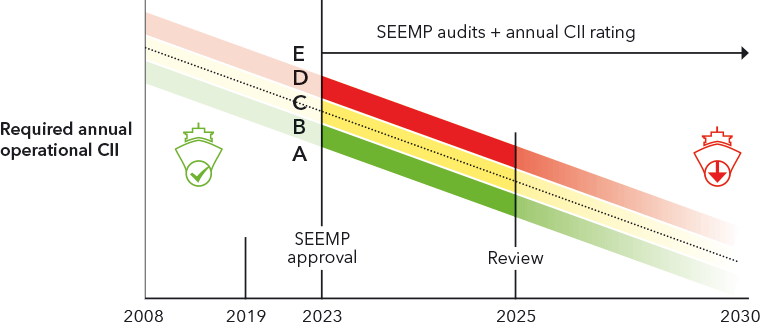
At Greenships, we recognize the paramount importance of operational energy efficiency in reducing the maritime industry's carbon footprint. As part of our commitment to sustainability, we actively prepare Ship Energy Efficiency Management Plan (SEEMP) Part III for our clients to help achieve the required Carbon Intensity Indicator (CII).
SEEMP Part III is a ship-specific and mandatory document that outlines a dynamic plan for improving the vessel's operational energy efficiency over the next three years. This plan is subject to regular updates and revisions, reflecting changing performance and incorporating required measures to enhance the vessel's overall environmental performance.
The dynamic nature of SEEMP Part III allows for flexibility in adapting to evolving industry standards, technological advancements, and changing operational conditions. Our dedicated team of experts collaborates closely with shipowners to create customized SEEMP Part III documents that not only meet regulatory requirements but also align with the client's specific operational goals and sustainability objectives.
Starting from 1 January 2023, SEEMP Part III, along with the Confirmation of Compliance (CoC), will be a vital document to be verified and kept on board respective vessels. Greenships takes pride in preparing our clients for this regulatory landscape, ensuring that their vessels are not only compliant but also equipped to continually improve operational energy efficiency.
By choosing Greenships, shipowners partner with a team dedicated to navigating the complexities of SEEMP Part III, achieving CII improvement, and contributing to a more sustainable and environmentally conscious maritime industry.
13
Preparation of EEDI Technical File
Energy Efficiency Design Index
Greenships is at the forefront of ensuring compliance with the Energy Efficiency Design Index (EEDI) regulations, a critical component in the effort to enhance energy efficiency and reduce the environmental impact of ships. The amendments to MARPOL Annex VI, adopted at the 62nd session of the Marine Environment Protection Committee (MEPC 62) in July 2011, made the regulation of EEDI and Ship Energy Efficiency Management Plan (SEEMP) mandatory, entering into force on 1 January 2013.
Read more Show less about Preparation of EEDI Technical File
The EEDI regulation applies to ships of 400 gross tonnage and above engaged in international voyages (excluding platforms, drilling rigs, and non-mechanically propelled vessels like barges). An International Energy Efficiency (IEE) Certificate is issued for ships complying with the regulation, verified through initial surveys for new ships or during the first intermediate or renewal survey of the International Air Pollution Prevention (IAPP) Certificate for existing ships, on or after 1 January 2013.
Notwithstanding the above, the EEDI regulation is specifically applicable to new ships falling into categories designated by the Convention. Greenships takes pride in its role as a leading provider in the preparation of EEDI Technical Files for clients, leveraging our dedicated professional software powered by Artificial Intelligence.
We meticulously consider all operational matrices for each type of vessel to ensure accurate and comprehensive EEDI Technical Files. By choosing Greenships, shipowners benefit from our commitment to compliance, innovative technologies, and a proactive approach to meeting and exceeding regulatory standards. Our goal is to empower our clients to navigate the evolving maritime landscape while optimizing energy efficiency and contributing to a sustainable and environmentally conscious industry.

Next waypoint
Which of the thirteen do you need?
Tell us your fleet size, vessel types and which regulations you are reporting under this year.
Contact us